Last Updated: November 22, 2026
Quick Summary
Chiropractic rehabilitation for shoulder injuries assesses how the shoulder, shoulder blade and upper spine move together, then rebuilds strength and control instead of stopping when pain settles. Care may combine joint adjustment, soft tissue therapy and rehabilitative exercises, progressed in phases until you meet return-to-activity criteria.
- A movement assessment checks range of motion, shoulder blade motion, spine mobility and rotator cuff strength.
- Strengthening is typically dosed 2 to 3 times per week, 2 to 3 sets of 8 to 15 reps.
- Rehabilitation moves through four phases, and you progress by meeting criteria, not by the calendar.
- Feeling pain-free is not the same as being ready to return to sport or work.
- Dr. Mark Strudwick has over 25 years in practice and an International Certificate in Sports Chiropractic.
Table of Contents
- Why Shoulder Injuries Keep Coming Back
- Shoulder Injury Rehabilitation Exercises You Can Do at Home
- Rotator Cuff Rehabilitation Exercises That Build Real Strength
- How Long Shoulder Injury Recovery Time Really Is
- When to Seek Care for Shoulder Pain
- How Chiropractic Care Fits Into Shoulder Rehabilitation
- Book a Shoulder Assessment at Strudwick Chiropractic
- Frequently Asked Questions
Why Shoulder Injuries Keep Coming Back
Most shoulder injuries return for one reason: the treatment stopped when the pain did. Chiropractic rehabilitation for shoulder injuries works differently.
A common pattern is that a patient rests, feels better, returns to sport or work, and the pain comes back weeks later. For a closer look at why this cycle repeats, see preventing recurring sports injuries.
The shoulder is the most mobile joint in the body, and that mobility comes at a cost.
That is why a shoulder injury needs a movement assessment before an exercise plan makes sense.
What a Movement Assessment Actually Looks For
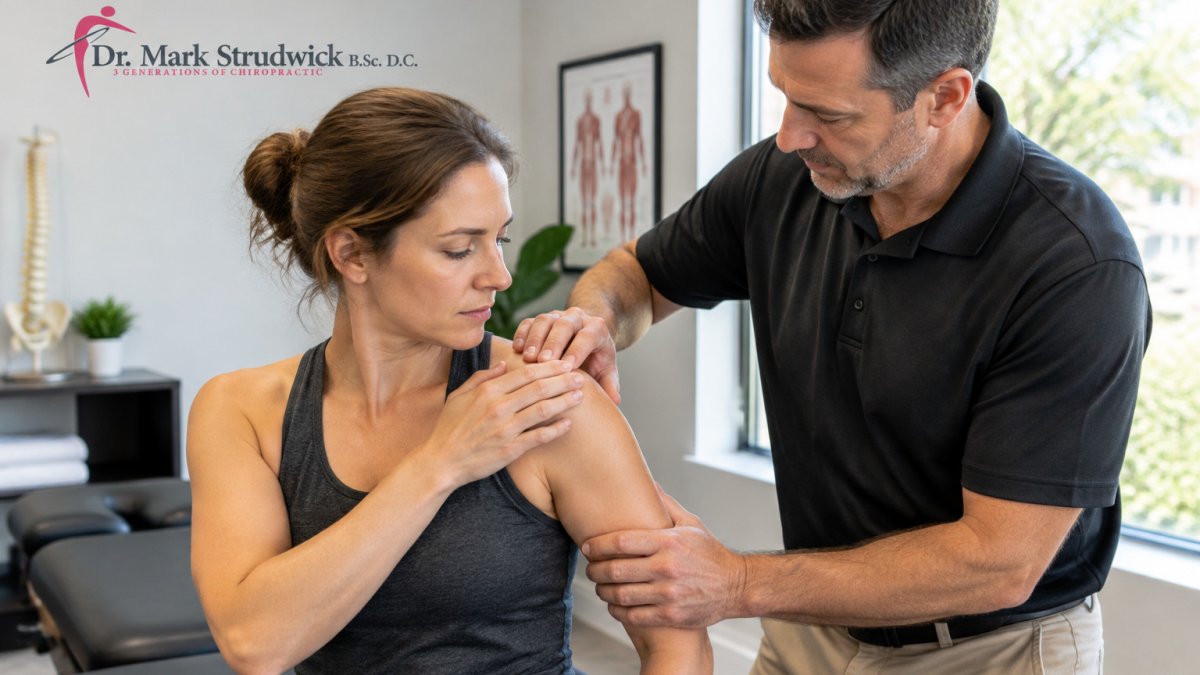
A movement assessment checks how your shoulder, shoulder blade, and upper spine work together during real motion. It looks for stiffness, weakness, and compensation patterns that load tissue unevenly.
We test range of motion in several directions. We watch the shoulder blade as the arm lifts.
The goal is to find the cause, not just the sore spot. You can see what our movement assessment in Victoria, BC involves and book a time to have it done.
Shoulder Injury Rehabilitation Exercises You Can Do at Home
Home exercise is where most recovery actually happens. A clinic visit may last 30 minutes; the other six days of the week belong to you. The exercises below are general starting points, not a prescription.

How to Dose and Progress Home Exercises
Dosage matters as much as exercise choice. A common dosing pattern is:
- Mobility work: daily, 1 to 2 sets of 8 to 10 slow reps or 20 to 30 second holds per movement.
- Isometrics: daily or near-daily early on, 4 to 5 holds of 10 to 30 seconds at a mild to moderate effort.
- Strengthening: 2 to 3 times per week, 2 to 3 sets of 8 to 15 reps, with a day of relative rest between sessions for the same muscle group.
Progress one variable at a time: add reps first, then resistance, then range. Increase only when the current dose feels controlled during the set and produces no more than mild soreness that settles within a day.
Watch out: a good day is not a green light to double the dose. The most common home-program mistake is progressing because pain is low, not because strength and control have actually improved.
Stretching and Mobility Work
Start with gentle range of motion, never forcing a painful end range.
- Pendulum swings: lean forward, let the arm hang, and make small circles for 30 seconds each direction.
- Doorway stretch: place your forearm on a door frame and step through to open the chest. Hold 20 to 30 seconds.
- Wall slides: slide your forearms up a wall while keeping ribs down. Ten slow reps.
Mild discomfort is acceptable. Sharp pain is a signal to stop.
Strengthening for Shoulder Stability
Strength work comes once pain is settling. These exercises target the rotator cuff and shoulder blade muscles that keep the joint centered.
- Banded external rotation: elbow at your side, rotate the forearm outward against a band. Two sets of 10 to 15.
- Rows: pull a band toward your ribs, squeezing the shoulder blades together.
- Wall push-ups: a low-load way to build pressing strength early on.
Add load or reps only when the current level feels controlled. A common mistake is progressing too fast because a good day feels like a green light.
Match the Exercise to the Injury
Shoulder pain is not one condition, and the same home program does not fit all of them. Use these modifications as a guide, and have a clinician confirm them for your case.
- Rotator cuff tendinopathy: loading is the treatment. Favor slow, controlled external and internal rotation and scapular work, and expect some mild discomfort during loading that settles afterward. Complete rest tends to make tendons more sensitive, not less.
- Partial rotator cuff tear: avoid heavy overhead pressing and sudden loaded end-range positions. Keep resistance moderate and range comfortable, and progress strength before range.
- Shoulder instability: emphasize control and scapular stability over end-range stretching. Avoid aggressive cross-body and doorway stretches that push the joint toward its loose direction.
Home-Program Safety and Technique
A few technique points prevent most setbacks:
- Keep the ribs down and avoid arching the low back during wall slides and overhead work.
- Move the shoulder blade, not just the arm, during rows and raises.
- Use a band you can control for the full range; a heavier band with a jerky rep trains nothing useful.
If a new exercise causes pain that lasts more than a day, drop back to the previous level rather than pushing through. If symptoms change in character, such as new weakness or numbness, stop the program and get assessed.
Rotator Cuff Rehabilitation Exercises That Build Real Strength
Rotator cuff rehabilitation exercises work best when they are slow and controlled, not heavy. The cuff muscles are small. They respond to quality reps and steady progression.
Four exercises form the base of most programs:
- Isometric external rotation: push against a wall or door frame and hold 10 seconds. No movement, just tension.
- Side-lying external rotation: lie on the unaffected side and rotate a light weight upward.
- Banded internal rotation: elbow at the side, pull the forearm inward against resistance.
- Scapular retraction with band: pull the shoulder blades back and down, holding two seconds at the end.
What most guides miss is the shoulder blade. A strong cuff attached to a poorly controlled shoulder blade still loads the joint badly. Train both together, and progress by adding reps before adding weight.
How Long Shoulder Injury Recovery Time Really Is
Shoulder injury recovery time depends on the tissue involved, your age, your baseline strength, and how consistent you are with rehabilitation. There is no single number that fits everyone.
As a general guide:
| Injury type | Typical recovery window | Main focus |
|---|---|---|
| Mild strain | A few weeks | Settle pain, restore motion |
| Rotator cuff tendinopathy | Several weeks to a few months | Load management, progressive strength |
| Partial cuff tear | Often two to three months or longer | Gradual strengthening, movement control |
| Post-surgical repair | Months, guided by the surgeon | Protected motion, then staged loading |
These are general ranges, not promises. Some people move faster; others need more time. Pushing through pain usually extends recovery rather than shortening it.
A Phase-by-Phase Rehabilitation Plan
Rather than counting weeks, most rehabilitation programs move through phases.
Phase 1: Settle pain and protect. The goal is to calm irritated tissue and keep gentle motion.
Phase 2: Restore mobility. The goal is to regain range in all directions without compensation.
Phase 3: Build strength. The goal is to load the rotator cuff and scapular muscles progressively.
Phase 4: Return to activity. The goal is to rebuild capacity for work, sport, and overhead tasks.
Measurable Milestones to Track Progress
Recovery is easier to judge with a few simple measures taken every couple of weeks:
- Pain response: a 0 to 10 rating at rest and with activity, and how long soreness lasts after exercise.
- Range of motion: compare lifting, reaching across the body, and rotating outward against the other shoulder.
- Strength: compare resisted rotation and rows side to side, and note whether the quality of the rep holds.
A common pattern is steady improvement in one measure before the others. That is normal. What matters is the trend over weeks, not day-to-day fluctuations.
Return-to-Sport and Return-to-Work Criteria
Returning before capacity is rebuilt is one of the most common reasons shoulder injuries recur. Most practitioners use criteria rather than a fixed date:
- Pain is minimal during the required activity and does not linger the next day.
- Range of motion is close to the other side for the movements the activity demands.
- Strength is near symmetrical for the relevant muscles.
Watch out: feeling pain-free is not the same as being ready. If you return to overhead sport or heavy lifting on pain alone, the original overload pattern often comes back within weeks.
When to Seek Care for Shoulder Pain
Seek care promptly if you cannot lift your arm, have had a fall or collision, or the pain came with weakness, numbness, or a deformity.
Book an appointment if shoulder pain lasts more than a week or two, wakes you at night, or keeps you from work, sport, or sleep.
Watch out: some symptoms are red flags, not shoulder problems.
If you are deciding whether to get care, our chiropractor in Victoria, BC page explains what a first visit involves.
How Chiropractic Care Fits Into Shoulder Rehabilitation
Chiropractic care for shoulder injuries focuses on joint mechanics, soft tissue, and movement quality. It does not replace medical assessment.
At Strudwick Chiropractic, Dr. Mark Strudwick has over 25 years in practice and holds an International Certificate in Sports Chiropractic. Care starts with a full physical, orthopedic, and neurologic exam before any treatment decision.
From there, treatment may combine:
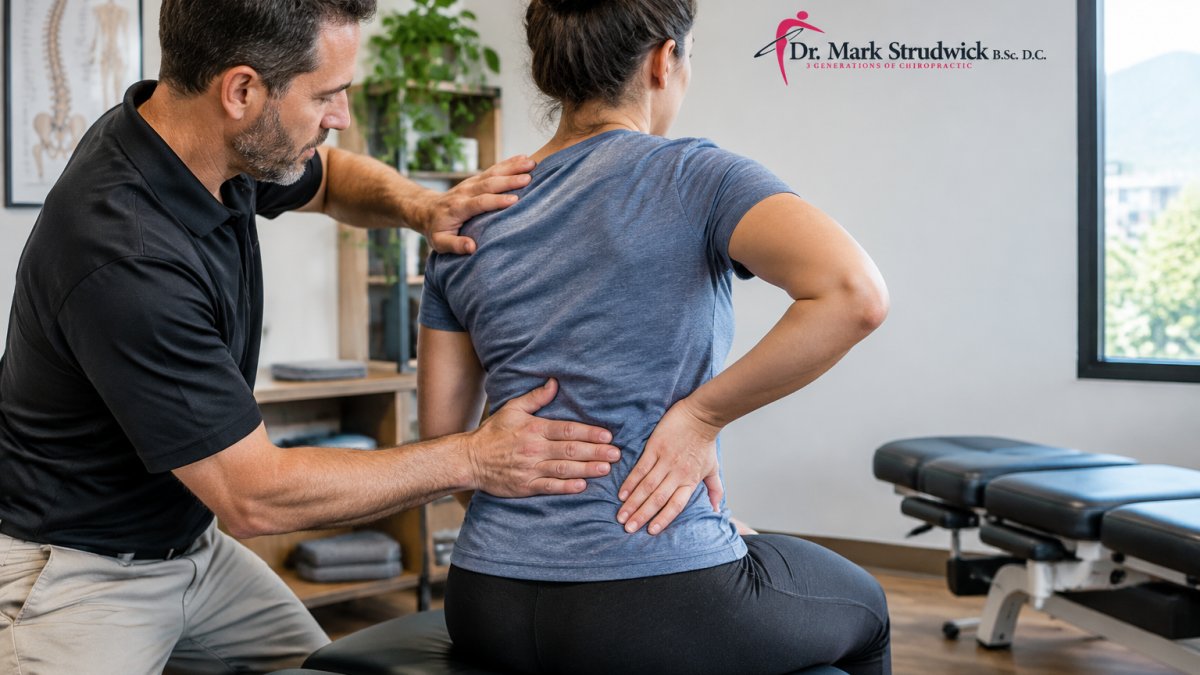
- Joint adjustment of the shoulder, upper back, or neck where movement is restricted
- Soft tissue therapy, done by hand or with low-level laser therapy
- Rehabilitative exercises, which are always part of the plan
A tailored plan built around your assessment findings is the approach at Strudwick Chiropractic, and the exercises are the part that supports lasting results. You can read more about Dr. Mark Strudwick and his background.
Book a Shoulder Assessment at Strudwick Chiropractic
Recurring shoulder pain rarely fixes itself with rest alone.
At Strudwick Chiropractic, we offer a thorough movement assessment, joint adjustment, soft tissue therapy including low-level laser, and rehabilitative exercise built into every plan.
Get started with Strudwick Chiropractic and find out what is actually driving your shoulder pain. For hours, location, and booking details, see our contact information.
If shoulder pain keeps returning, the missing piece is usually a plan, not another week of rest.
Frequently Asked Questions
Can chiropractic care help with shoulder injuries?
Yes, for many soft-tissue and mechanical shoulder problems. Chiropractic rehabilitation for shoulder injuries combines joint adjustments, soft tissue therapy, and targeted exercise to restore range of motion and shoulder stability. At Strudwick Chiropractic, care starts with a physical, orthopedic, and neurologic examination so the treatment plan matches the actual problem. Care is not appropriate for every shoulder issue, though. Fractures, full-thickness tears, and suspected dislocations need medical assessment first, and a chiropractor should refer you out when those red flags appear.
What exercises can help rehabilitate a shoulder injury?
Shoulder injury rehabilitation exercises usually fall into three groups. Mobility work such as pendulum swings and wall slides restores range of motion. Strengthening exercises like banded external rotation, scapular retraction, and rows build muscle strength around the shoulder joint. Control work such as serratus punches and prone Y-raises improves shoulder stability. Start with low resistance and pain-free ranges, then add load as movement quality improves. A clinician should tailor the mix to your specific injury, because rotator cuff rehabilitation exercises differ from what helps a stiff shoulder.
How long does shoulder injury rehabilitation take?
Shoulder injury recovery time depends on the tissue involved. Recovery time varies with the tissue involved, and minor strains usually take less time than rotator cuff injuries, which generally take longer to regain strength. Progress is measured by range of motion, strength, and pain-free function rather than by a fixed calendar, so your timeline should be reassessed as you go.
When should I see a chiropractor for shoulder pain?
Seek care when shoulder pain lasts more than a week or two, keeps you from sleeping, limits overhead reaching, or comes back after previous treatment. Weakness in the arm, a visible deformity, or pain after a fall needs prompt medical assessment before any manual treatment. At Strudwick Chiropractic, a comprehensive examination comes first, and if findings point to something outside chiropractic scope, you are referred to the appropriate care. Early assessment helps identify the right next step sooner.