Table of Contents
- Why Sitting Causes Back Pain and How Stretching Helps
- 7 Stretches for Back Pain From Sitting (Step-by-Step)
- Seated Stretches for Lower Back Pain You Can Do at Your Desk
- Exercises for Lower Back Pain From Sitting: Beyond Stretching
- How to Decompress Your Back While Sitting
- Stretches for Seniors With Lower Back Pain
- When to Stop Stretching and Seek Professional Care
- Frequently Asked Questions
Last Updated: October 19, 2026
Why Sitting Causes Back Pain and How Stretching Helps
Sitting for long stretches keeps your hip flexors short and your glutes inactive. That combo can affect your pelvis and loads your lower back. Stretching helps by restoring range of motion and easing muscle tension. (Source: Statistics Canada’s 2022 Canadian Health Survey)
At Strudwick Chiropractic, we see this pattern constantly in office workers. The spine isn’t the problem. The static posture is.
Here’s what happens: your hip flexors tighten, your glutes switch off, and your lower back takes the load. Day after day, that adds up to lack of mobility in the hips and its resultant stiffness and ache.
The good news is that simple stretches for back pain from sitting can reverse much of this. You don’t need a gym. A chair and five minutes will do.
The best stretches for back pain from sitting target hips, glutes, and spine together. Stretching only your lower back misses the muscles that caused the problem.
7 Stretches for Back Pain From Sitting (Step-by-Step)
Below is a complete desk-friendly sequence you can run without a mat or a change of clothes. Each move takes 30 to 60 seconds. The full routine runs about six to eight minutes, and you can split it into two shorter blocks if your calendar is tight.
Do them slowly and breathe. Never bounce into a stretch. Move until you feel a gentle pull, not sharp pain.
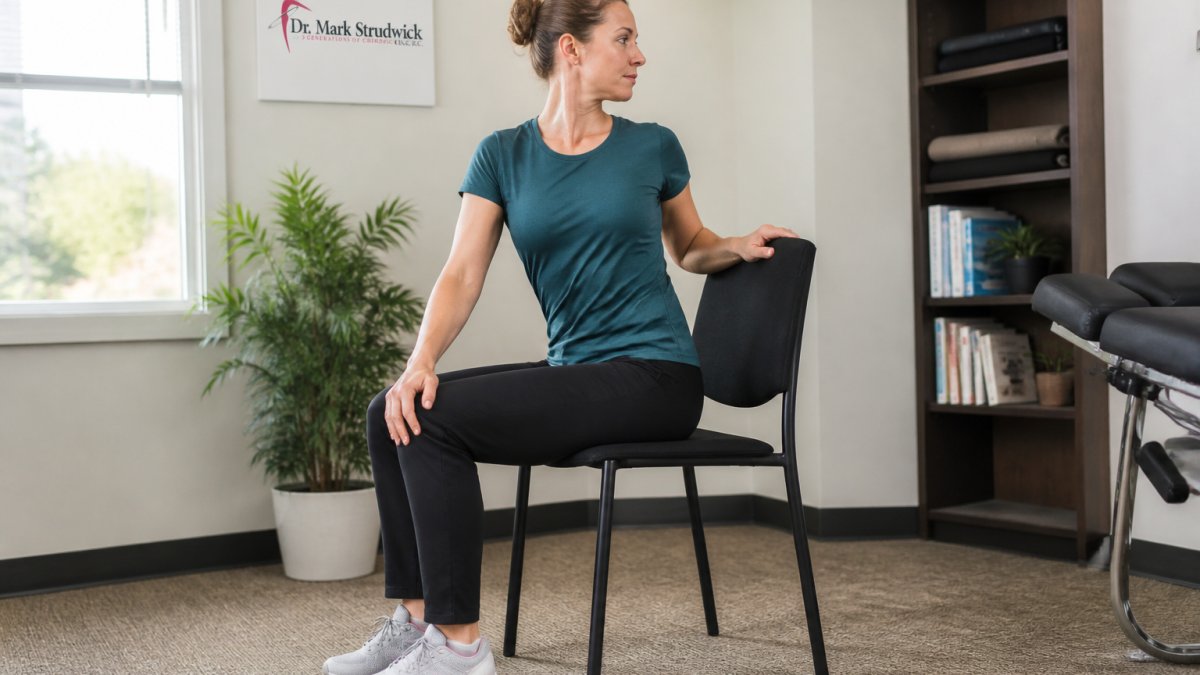
1. Seated Spinal Twist
Sit tall with feet flat and hips square. Place your right hand on the chair back and your left hand on your right knee. Rotate gently and hold for 20 to 30 seconds. Switch sides. This restores spinal rotation and eases the stiffness that builds when you hold one position all day. Keep the movement small, a few degrees of rotation is enough.
2. Seated Forward Bend
Sit tall with feet flat on the floor. Hinge forward from the hips and let your hands slide toward your shins. Hold for 30 seconds. You should feel a gentle stretch through the lower back and hamstrings. If your hamstrings are tight, bend your knees slightly or place your hands on your thighs instead of reaching for your shins.
3. Seated Knee Hug
Sit toward the front of the chair. Pull one knee toward your chest with both hands and hold for 20 seconds. Switch sides. This targets the lower back and buttocks without requiring you to get on the floor. Keep your other foot flat so you stay stable.
4. Neck and Chest Stretches
Sit tall. Tilt your ear toward one shoulder and hold for 20 seconds per side. Then clasp your hands behind your back and open your chest. Hold for 20 seconds. These counter the forward slump of desk work and relieve the upper-back tightness that often travels with lower-back pain.
5. Cat-Cow Stretch
If you have floor space, start on hands and knees. Arch your back up, then let it dip down. Move slowly through 8 to 10 repetitions. This improves spinal mobility and warms up the muscles. If getting to the floor is not practical, do a seated version: sit tall, round your spine forward, then arch gently back, moving through the same 8 to 10 repetitions.
6. Knee-to-Chest Stretch
Lie on your back. Pull one knee toward your chest with both hands. Hold for 30 seconds, then switch sides. This eases tension in the lower back and buttocks. If lying down is uncomfortable, use the seated knee hug above as a substitute.
7. Standing Hip Hinge
Stand with feet hip-width apart and knees soft. Push your hips back as if closing a drawer with your buttocks, keeping your back flat. Return to standing. Do 10 slow repetitions. This teaches the hip hinge you need to lift and sit without loading your lower back.
Do the seated spinal twist first and the standing hip hinge last. The twist loosens the spine before you load it, and the hinge finishes the routine with a movement pattern you use all day.
How long to hold and how often to repeat
Hold each stretch for 20 to 30 seconds and repeat the sequence once or twice per day. A common pattern is one full routine mid-morning and a shorter two-stretch break in the afternoon. Most people notice less stiffness within one to two weeks of consistent practice, though relief varies.
Modifications for different mobility levels
- Chair-based only: do stretches 1, 2, 3, 4, and the seated version of 5.
- Standing only: do the standing hip hinge, a standing chest opener, and a standing side bend.
- Floor-based: add the knee-to-chest stretch and the full cat-cow.
Stop any stretch that causes sharp pain, numbness, or tingling, and see the stop-or-seek-care guidance below.
Seated Stretches for Lower Back Pain You Can Do at Your Desk
Seated stretches for lower back pain work well because they fit into your day. No mat, no change of clothes.
Try these three at your chair:
- Seated forward bend: hinge from the hips, hold 30 seconds
- Seated spinal twist: rotate gently each way, hold 20 seconds
- Seated knee hug: pull one knee toward your chest, hold 20 seconds
The trick is timing. A common mistake is saving all your stretching for the end of the day. Short breaks beat one long session.
Stand up every 30 to 45 minutes. Do one stretch. Sit back down. That rhythm keeps stiffness from building up.
Exercises for Lower Back Pain From Sitting: Beyond Stretching
Stretching alone won’t fix a weak back. Exercises for lower back pain from sitting need to build strength too. (Source: Health Canada’s guidelines on physical activity)
Focus on the glutes and core. These muscles support your spine when you sit and stand.
- Glute bridges: lie on your back, lift your hips, 10 to 15 reps
- Bird dog: on hands and knees, extend opposite arm and leg, 8 per side
- Dead bug: lie on your back, lower opposite arm and leg slowly, 8 per side
- Standing hip hinge: practise hinging at the hips, 10 reps
Start with two sessions a week. Add load or reps only when the movements feel easy.
If pain flares, back off. Strength work should feel controlled, not sharp.
How to Decompress Your Back While Sitting
Knowing how to decompress your back while sitting comes down to setup and movement. You cannot stretch a spine that stays compressed all day. The goal is to reduce the load on your lower back and change position often enough that stiffness never builds up.
Set up your chair and desk first
- Feet flat on the floor, knees bent at about 90 degrees. If your feet do not reach, use a footrest.
- Screen at eye level so your neck stays neutral and your chin does not drift forward.
- Chair back supporting your lower back curve. A small lumbar roll or a rolled towel works if your chair lacks support.
- Elbows near 90 degrees at the keyboard, with wrists straight.
- Monitor about an arm’s length away, so you are not leaning in.
Add movement habits that decompress the spine
Setup alone will not fix a day of sitting. Pair it with a movement rhythm:
- Stand up every 30 to 45 minutes. Even 60 seconds of walking resets the load on your discs and hip flexors.
- Roll your shoulders and gently extend your upper back every hour.
- Take a short walk at lunch and after work. Walking is one of the simplest ways to decompress the spine because it alternates loading and unloading.
- Avoid the soft couch or the slumped “working from the sofa” setup. It undoes every stretch you do.
A simple decompression sequence
When you feel compression building, try this two-minute reset:
- Stand and place your hands on your hips.
- Gently arch back a few degrees and hold for five seconds. Repeat three times.
- Do a slow standing hip hinge for 10 repetitions.
- Walk for 60 seconds.
This sequence alternates extension and movement, which is the pattern most practitioners recommend for sitting-related stiffness.
A soft couch or a slumped setup undoes every stretch you do. Support your lower back and keep your feet grounded.
When setup and movement are not enough
If stiffness persists despite good setup and regular breaks, the cause may be more than posture. See the stop-or-seek-care guidance below before adding more stretching.
Stretches for Seniors With Lower Back Pain
Stretches for seniors with lower back pain should be gentler and slower. Range of motion matters more than depth.
Safe options include:
- Seated spinal twist, done slowly
- Seated forward bend with a small hinge only
- Knee-to-chest stretch, one leg at a time
- Neck and shoulder rolls
Use a chair with arms for support when standing up. Hold each stretch for 20 to 30 seconds. Stop if you feel sharp pain, numbness, or dizziness.
Many older adults find heat therapy helps before stretching. A warm shower or heat pack loosens tight muscles.
If balance is a concern, do floor stretches near a wall or with someone nearby.
When to Stop Stretching and Seek Professional Care
Most sitting-related stiffness improves with movement. Some symptoms don’t. Stop and get assessed if you notice:
- Pain that shoots down a leg
- Numbness, tingling, or weakness
- Pain after a fall or accident
- Bladder or bowel changes
- Pain that worsens despite weeks of stretching
These signs need a proper exam, not more stretches. A qualified professional can tell general stiffness apart from something that needs treatment.
At Strudwick Chiropractic, Dr. Mark Strudwick brings over 25 years of experience and an International Certificate in Sports Chiropractic. Care combines adjustive techniques, soft tissue therapy, and rehab exercises. We also offer direct billing to insurance plans, ICBC, and WorkSafe.
Frequently Asked Questions
What stretches help back pain from sitting?
The most effective stretches for back pain from sitting target the lower back, hips, and chest. Try the knee-to-chest stretch, cat-cow, seated forward bend, seated spinal twist, and neck and chest stretches. Hold each for 20 to 30 seconds and repeat two to three times per side. A short routine of five to seven minutes, done two or three times a day, can ease stiffness and muscle tension. If pain worsens or persists, consult a healthcare professional.
How often should I take a stretch break when sitting?
Aim to stand up and move every 30 to 45 minutes. Even a one- to two-minute stretch break helps reset static posture and reduce stiffness. Set a timer or use a standing reminder. During each break, do one or two seated stretches for lower back pain, such as a gentle spinal twist or a seated forward bend. Consistency matters more than duration, so short, frequent breaks beat one long stretching session.
Can I stretch my lower back while sitting at a desk?
Yes. Seated stretches for lower back pain are safe for most people and easy to do at a desk. Try a seated spinal twist: sit tall, place your right hand on the chair back, left hand on the right knee, and turn gently to the right. Hold for 20 seconds, then switch sides. You can also do a seated forward bend or a gentle neck stretch. Keep movements slow and stop if you feel sharp pain.
When should I seek professional help for back pain?
Seek professional care if back pain lasts more than a few weeks, worsens despite stretching, or comes with numbness, weakness, or tingling in the legs. Also get help if pain follows a fall or injury, or if you have trouble controlling your bladder or bowels. A chiropractor or physiotherapist can assess your posture and movement patterns, then recommend exercises for lower back pain from sitting that fit your needs.
Sitting-related back pain rarely fixes itself without a plan. Stretching helps, but lasting relief usually needs a proper assessment and a program built around your body. Strudwick Chiropractic offers evidence-based care, tailored rehab exercises, and direct billing to insurance, ICBC, and WorkSafe. Book your visit and get back to moving without the ache.