Table of Contents
- Lower Back Pain Exercises for Beginners: Where to Start
- Lower Back Stretches for Pain: 4 Gentle Moves to Try First
- Beginner Lower Back Strengthening Exercises That Build Support
- A 15-Minute Lower Back Pain Workout You Can Do at Home
- Exercises for Chronic Lower Back Pain: Adapting as You Progress
- Common Mistakes Beginners Make With Lower Back Pain Exercises
- When to Stop and Seek Professional Care
- Frequently Asked Questions
Last Updated: October 16, 2026
Lower Back Pain Exercises for Beginners: Where to Start
Lower back pain exercises for beginners work best with gentle, controlled movement rather than force. This guide from Strudwick Chiropractic covers seven beginner-friendly moves, a short home routine, and clear signals for when to stop.
Most everyday lower back pain responds well to gentle movement, and you don’t need a gym or special gear to begin. Below, we’ll show you how to start and how to build up safely.
What You’ll Need Before You Begin
You need very little to start lower back exercises at home:
- A firm, flat surface, such as a yoga mat or carpeted floor
- A pillow or folded towel for head support
- Loose, comfortable clothing
If you have a diagnosed condition, recent injury, or ongoing pain, check with a health professional before starting. For general guidance on back health, the Canadian Chiropractic Association’s back health resources is a useful starting point.
How to Tell a Comfortable Stretch From a Warning Sign
A comfortable stretch feels like gentle tension that eases as you hold it. A warning sign feels sharp, shooting, or numb, and gets worse, not better.
Use this simple test:
| What You Feel | What It Means | What to Do |
|---|---|---|
| Mild pulling in the back or buttocks | Normal stretch | Hold and breathe |
| Sharp or shooting pain | Nerve irritation | Stop and rest |
| Numbness or tingling down the leg | Possible nerve involvement | Stop and seek advice |
| Pain that worsens with each rep | Too much, too soon | Reduce range or stop |
Pushing through sharp pain is the fastest way to turn a mild flare-up into a long recovery. If a movement hurts more with every repetition, stop. Soreness should fade, not build.
Lower Back Stretches for Pain: 4 Gentle Moves to Try First
These four lower back stretches for pain target the muscles that tighten most when your back is sore. Move slowly and hold each 15 to 30 seconds.
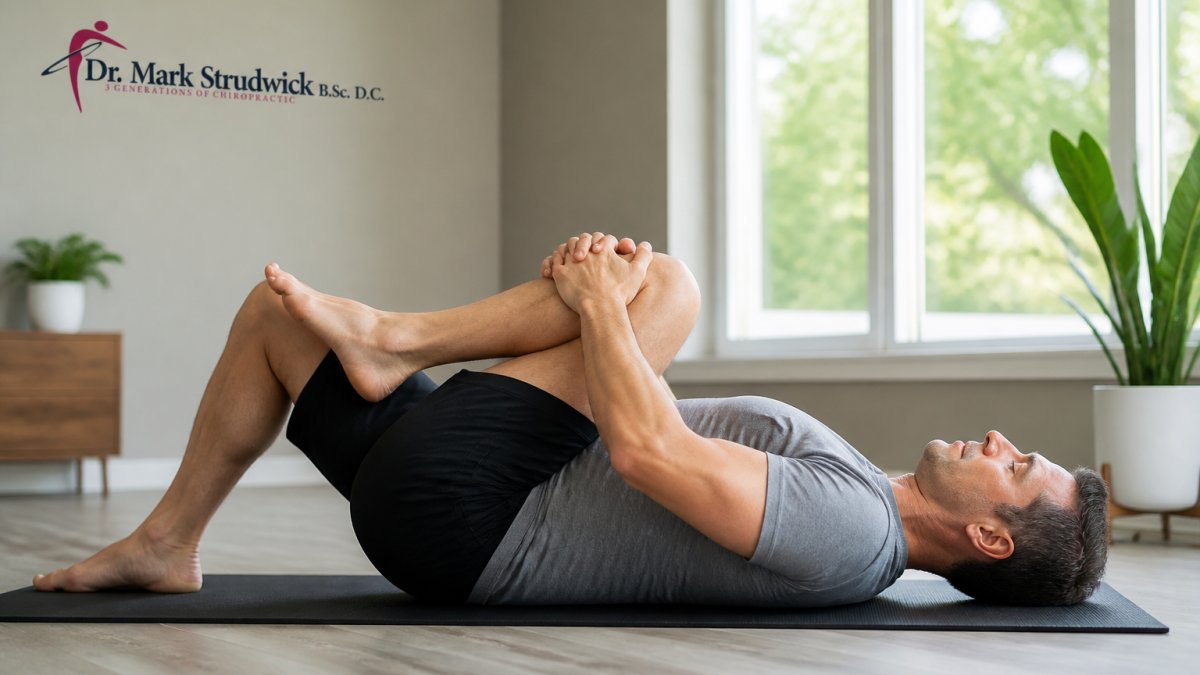
Knee-to-Chest Stretch
Lie on your back with your knees bent and your feet flat on the floor. Bring one knee toward your chest and clasp your hands under the knee. Hold for 15 to 30 seconds, then switch sides. Keep your lower back relaxed against the floor.
Pelvic Tilt and Knee Rolls
A pelvic tilt teaches you to control your lower back without straining it. Lie on your back, knees bent, feet flat. Flatten your lower back against the floor, hold five seconds, release. Then do slow knee rolls: let both knees fall to one side, hold briefly, then the other.
Cat-Camel and Child’s Pose
The cat-camel gently mobilizes the spine. On your hands and knees, slowly arch your back up, then let it sag down, moving with your breath. Finish with child’s pose: sit back on your heels, reach your arms forward, and let your back lengthen.
Breathe out as you move into each stretch. Holding your breath tightens the muscles you’re trying to relax, which defeats the purpose.
Beginner Lower Back Strengthening Exercises That Build Support
Stretching eases tension, but beginner lower back strengthening exercises build the support that keeps pain from returning. Add these once stretching feels easy.
Supine Bridge
Lie on your back, knees bent, feet flat and hip-width apart. Press through your feet and lift your hips a few inches. Squeeze your buttocks at the top, hold two seconds, lower slowly. Start with 8 to 10 reps.
Bird Dog
On your hands and knees, reach one arm forward and the opposite leg back, keeping your trunk steady. Hold three seconds, then switch sides.
For context on how exercise fits into broader back care, the World Health Organization’s guidance on physical activity notes that regular movement supports musculoskeletal health at every age.
A 15-Minute Lower Back Pain Workout You Can Do at Home
A list of exercises is not a routine. What makes a beginner program work is the order, the warm-up, how often you do it, and what you change when your back responds differently.
The Warm-Up (2 Minutes)
Never start cold. Walk at an easy pace for two minutes, or march in place with relaxed arms. The goal is warmth, not effort, you should be able to talk normally. If walking is uncomfortable, march seated instead: sit tall in a firm chair, lift one knee a few inches, lower it, then the other.
The Main Session (About 12 Minutes)
| Step | Exercise | Time or Reps | Why It’s Here |
|---|---|---|---|
| 1 | Pelvic tilt | 10 reps, 5-second holds | Wakes up deep core control before loading |
| 2 | Knee-to-chest stretch | 30 seconds each side | Releases the lower back after the tilt |
| 3 | Knee rolls | 30 seconds each side | Gentle rotation to keep the spine mobile |
| 4 | Cat-camel | 10 slow reps | Mobilizes the whole spine through a comfortable range |
| 5 | Child’s pose | 30 seconds | Decompresses and lets you check in with your breathing |
| 6 | Supine bridge | 8 to 10 reps | First strengthening move, low load |
| 7 | Bird dog | 5 reps each side | Builds trunk stability to protect the back |
Move from one step to the next without rushing. If a step causes sharp pain, skip it and continue, you don’t have to complete every move to benefit.
How Often, and How Long
- Frequency: Three to four sessions per week, with at least one rest day between sessions at the start.
- Duration: 12 to 15 minutes total. Longer is not better when you are beginning.
- Timeline: Give the routine two full weeks before judging it. Most beginners notice easier movement before they notice less pain.
Cool-Down (1 Minute)
Lie on your back with knees bent and breathe slowly, in through the nose for four counts, out through the mouth for six. This lowers muscle tension and lets you notice whether anything feels worse than when you started. (Source: Public Health Agency of Canada’s information on chronic pain)
Adapting the Routine to Your Day
- Short on time: Do steps 1, 2, 4, and 6 only. That is a complete session in about six minutes.
- Pain is higher today: Do only the stretches (steps 2, 3, 4, 5) and skip the strengthening moves.
- Feeling good: Add one repetition to the bridge and bird dog, or hold the stretches five seconds longer. Change one variable at a time.
Short and consistent beats long and occasional. Three focused 15-minute sessions a week will do more for your back than one exhausting workout, and the warm-up and cool-down are part of the session, not optional extras.
Exercises for Chronic Lower Back Pain: Adapting as You Progress
Chronic lower back pain, pain lingering beyond the usual few weeks, responds to movement, but not the same movement for everyone. The most useful skill you can build is learning which movements your back tolerates and which it doesn’t.
Match the Movement to How You Feel
Different symptoms often point toward different starting points. This is general guidance, not a diagnosis, if unsure, start with the gentlest option and see how your back responds the next day.
| If Your Back Feels… | Start With | Go Easy On |
|---|---|---|
| Stiff in the morning, looser as you move | Cat-camel, knee rolls, walking | Long static holds first thing |
| Sore after sitting all day | Knee-to-chest, pelvic tilt, standing extensions | Prolonged sitting without breaks |
| Aching and weak in the center | Pelvic tilt, supine bridge, bird dog | Heavy bending or lifting |
| Sharp with certain movements | Gentle range-of-motion only, then reassess | Anything that reproduces the sharp pain |
A practical test: do one set, then check how you feel immediately and the next morning. If it’s no worse, it’s likely a reasonable fit for now.
Easier Variations When the Standard Move Is Too Much
- Knee-to-chest: Instead of pulling with your hands, rest one foot on a chair seat and gently draw the other knee partway in. Or do it one leg at a time with a strap or towel around the thigh.
- Pelvic tilt: Do it lying down with knees bent, or seated upright in a firm chair if lying down is uncomfortable.
- Cat-camel: Reduce the range, small, slow movements count. You can also do a seated version: sit tall, gently round and arch the spine.
No-Floor and Bed-Based Alternatives
If getting down to the floor and back up is the hardest part of your day, you can still do a full session:
- Seated pelvic tilt: Sit tall in a firm chair, gently rock your pelvis forward and back.
- Seated knee lifts: Lift one knee a few inches, lower slowly, alternate sides.
- Seated spinal rotation: Cross your arms over your chest and turn gently to each side.
A sturdy chair with armrests and a firm mattress are enough equipment for a complete beginner routine.
When and How to Progress
When the routine above feels easy for two full weeks, progress, changing one thing at a time:
- Hold each stretch a little longer, up to 45 seconds.
- Add one or two repetitions per set.
- Slow your movements down, a slower bridge is harder than a fast one.
If pain flares, drop back to the easier version for a few days. Progress isn’t a straight line; setbacks are normal, two steps forward, one step back, then a new baseline better than where you started.
When to Pause Progression Entirely
Do not push through these:
- Pain that travels down the leg, or numbness or tingling in the leg or foot.
- Weakness in a leg or foot that was not there before.
- Pain that gets worse each session rather than settling within a day.
For everything else, a professional assessment can pinpoint what is driving your pain instead of guessing. At Strudwick Chiropractic, we build rehab programs around this exact principle, adjusting the plan as your body responds.
Common Mistakes Beginners Make With Lower Back Pain Exercises
The biggest mistake is doing too much too soon. Most beginners feel better after a few days and immediately add reps, weight, or new moves. That’s usually when pain returns.
Other common errors:
- Holding your breath during stretches
- Bouncing instead of holding still
- Skipping the strengthening work because stretching feels nicer
A common mistake is treating exercise as a short-term fix. The people who do best keep a simple routine going long after the pain fades.
When to Stop and Seek Professional Care
Stop exercising and seek care if you notice any of these:
- Severe pain that doesn’t ease with rest
- Numbness or weakness in your legs
- Loss of bladder or bowel control
The last two need urgent attention. For everything else, a professional assessment can pinpoint what’s driving your pain instead of guessing.
At Strudwick Chiropractic, Dr. Mark Strudwick holds an International Certificate in Sports Chiropractic (ICSC) and has over 25 years of experience. We use hands-on treatment, soft tissue therapy, and tailored rehab exercises.
Frequently Asked Questions
What is the best exercise for a painful lower back?
There is no single best move, but knee-to-chest stretches and pelvic tilts are common starting points because they are gentle and easy to control. For most beginners, a mix of light stretching and simple strengthening, such as bridges and bird dogs, works better than one exercise alone. Start with slow, controlled movement, hold stretches for about 15 to 30 seconds, and stop if pain increases rather than eases. A chiropractor or physiotherapist can tailor lower back pain exercises to your specific symptoms.
How long should I exercise when my lower back hurts?
A short session of about 10 to 15 minutes is enough when you are starting out. Aim for a few repetitions of each movement rather than long or intense workouts. If your back feels better during and after the session, you can gradually add repetitions over the following weeks. If pain worsens during exercise or lingers afterward, cut back and speak with a healthcare professional before continuing.
Should I stretch or strengthen my lower back?
Most beginners benefit from doing both, but starting with gentle stretches helps reduce stiffness before you add strengthening work. Once movement feels more comfortable, beginner lower back strengthening exercises like bridges and bird dogs help support the spine during daily activities. Alternate between the two within the same session, and keep the effort low enough that you can move without holding your breath.
When should I stop exercising because of lower back pain?
Stop right away if you feel sharp or shooting pain, numbness, tingling, or weakness in your legs, or if the discomfort keeps increasing as you move. These are signals to pause and get assessed by a qualified professional. Seek urgent care if you lose bladder or bowel control, or if back pain follows a fall or accident. Mild soreness that settles within a day is usually not a cause for concern.
Back pain rarely resolves on its own if you keep repeating what caused it. Whether it’s desk posture, a sports injury, or a workplace strain, the right plan makes recovery faster and lowers the odds of it coming back. Dr. Mark Strudwick offers evidence-based treatment, personalized rehab programs, and direct billing to insurance, ICBC, and WorkSafe. Book now with Strudwick Chiropractic and get back to moving without the fear of your next flare-up.