Table of Contents
- Functional Movement Victoria: What It Is and Who It Helps
- The Functional Movement Screen: What It Tests and What It Can’t Tell You
- What Happens During a Functional Movement Assessment
- Functional Movement Training: Building Capacity After the Screen
- Chiropractic Rehabilitation Exercises and Where They Fit
- Choosing a Provider and What Sessions Involve
- Conclusion
- Frequently Asked Questions
Last Updated: October 12, 2026
Functional Movement Victoria: What It Is and Who It Helps
[Functional movement](/movement-assessment/) is how your body handles real-life tasks: squatting, bending, reaching, pushing, pulling, and walking.
That distinction matters for anyone searching for functional movement victoria-style care: you want to know why the problem keeps returning, not just chase symptom relief.
Most people arrive with one of a few stories. Desk workers with stiff necks and aching lower backs.
Here is the honest part most clinic pages skip: a movement screen is a screening tool, not a diagnosis. It flags patterns worth investigating.
The Functional Movement Screen: What It Tests and What It Can’t Tell You
The Functional Movement Screen (FMS) is a set of seven movement tasks scored from 0 to 3, designed to identify limitations and asymmetries in basic movement patterns.
The seven tasks cover a squat, a hurdle step, an inline lunge, shoulder mobility, an active straight-leg raise, a trunk stability push-up, and a rotary stability pattern.
What the screen does well:
- Highlights left-right differences that may point to structural asymmetry
- Reveals limited range of motion in hips, shoulders, or ankles
- Creates a baseline you can retest later to track change
What it cannot do:
- Diagnose a specific injury or tissue damage
- Replace imaging, neurological testing, or a full clinical exam
- Predict future injury on its own with certainty
Screening research has been debated for years, and no responsible practitioner should claim a screen guarantees you will stay injury-free.
If a provider says the screen alone explains your pain, treat that as a red flag.
Skipping the examination and going straight to adjustments is a common mistake. A screen or a single posture photo cannot rule out nerve involvement, fracture, or other conditions that need a different approach. Ask what else the practitioner checked before recommending treatment.
What Happens During a Functional Movement Assessment
A functional movement assessment typically starts with a conversation, moves into observation and testing, and ends with a plain-language explanation of what was found.
Here is the general shape of a first appointment:
- History (10-15 minutes). What hurts, when it started, what makes it better or worse, and what you need to get back to doing. Bring a short list of goals, a specific lift, a run distance, a work task, or getting through a shift without pain.
- Observation (5 minutes). How you stand, sit, breathe, and shift weight at rest. This is where posture, breathing pattern, and resting alignment get noted.
- Movement testing (15-20 minutes). Squatting, bending, reaching, walking, and single-leg tasks. If the practitioner uses the Functional Movement Screen, this is where the seven scored tasks happen.
- Targeted strength and mobility checks (10 minutes). Range of motion, muscle strength, balance, and coordination, focused on whatever the movement testing flagged.
- Explanation and plan (10 minutes). What patterns showed up, what they likely mean, what the plan is, and when you will be retested.
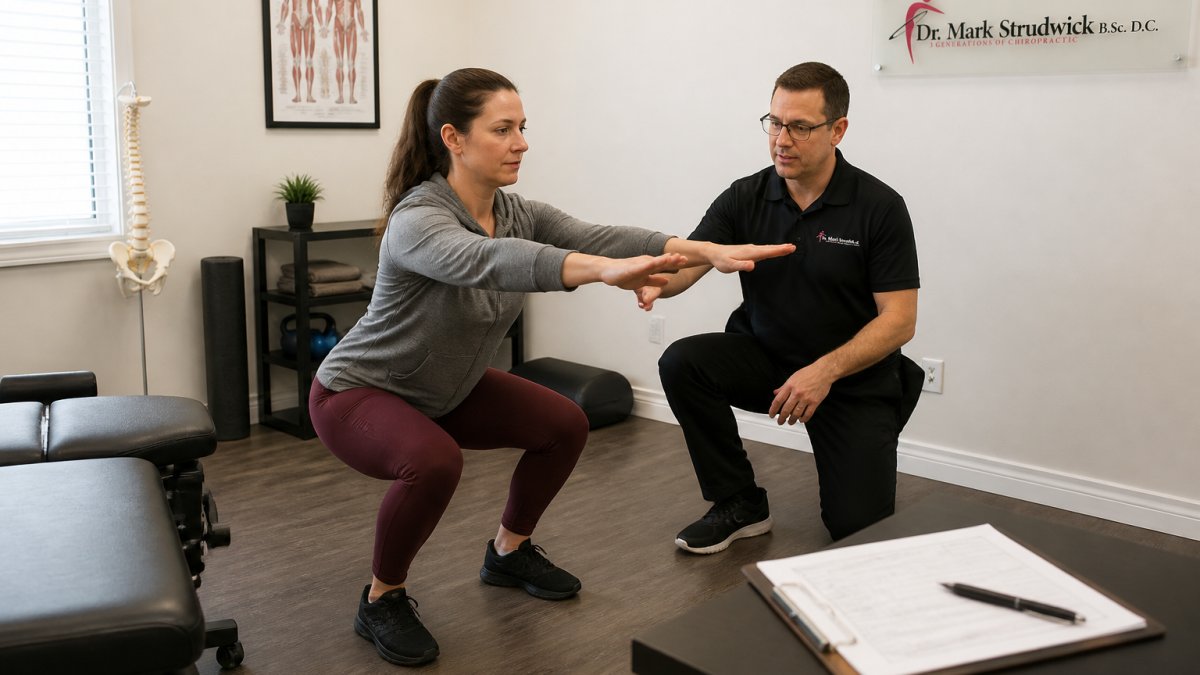
You should leave understanding your own body better, not just with a treatment schedule, and with a written or emailed summary if you ask, so you have something to compare against at the retest.
What to bring and how to prepare
- Wear or bring clothing you can move in, shorts and a t-shirt work better than jeans.
- Bring a list of medications, prior injuries, and any imaging reports you have.
- Note your coverage details: insurer name, policy number, and whether a doctor’s referral is required for reimbursement.
Coverage and billing, in plain terms
In this province, extended health plans commonly reimburse part or all of a chiropractic visit, but the amount depends on your plan, some cover a flat per-visit amount, some a percentage, and some cap visits per year. Two public systems are also relevant:
- WorkSafeBC covers treatment for accepted workplace injuries (Chiropractors). If your claim is accepted, the practitioner bills WorkSafeBC directly rather than you.
- ICBC covers treatment for injuries from a motor vehicle collision under its Enhanced Care model, and most clinics can bill ICBC directly for approved treatments.
Direct billing to extended health insurers is common but not universal. Ask before your first visit whether the clinic bills your insurer directly or whether you pay upfront and submit a receipt. MSP does not cover chiropractic visits for most adults, so plan for insurance reimbursement or out-of-pocket payment.
Questions worth asking during the visit:
- Which movement patterns were limited, and on which side?
- Is this a mobility problem, a strength problem, or both?
- What should I expect to feel after treatment, and what would be a warning sign?
The value of an assessment is not the score. It is the explanation. A good practitioner connects what they observed to what you actually want to do again, and tells you upfront how many visits and how much it will likely cost.
Functional Movement Training: Building Capacity After the Screen
Functional movement training turns assessment findings into a plan: the screen tells you where capacity is limited, and training builds it back progressively and measurably.
A useful program addresses mobility, strength, and control at once. Stretching alone rarely fixes a pattern; loading the tissue in a controlled way creates lasting change. (Source: guidelines for managing musculoskeletal pain)
What a plan typically includes:
- Corrective exercise for the specific restriction found in the assessment
- Strength work for the muscles that are not doing their share
- Multi-plane movement so you train rotation and side-to-side control, not just forward and back
The retest separates a real program from a list of stretches. If the pattern has not changed after a reasonable period, the plan needs adjusting, not repeating.
Your program should look different from the person next to you: two people with the same complaint can need opposite approaches depending on whether they are stiff, weak, or poorly coordinated.
Chiropractic Rehabilitation Exercises and Where They Fit
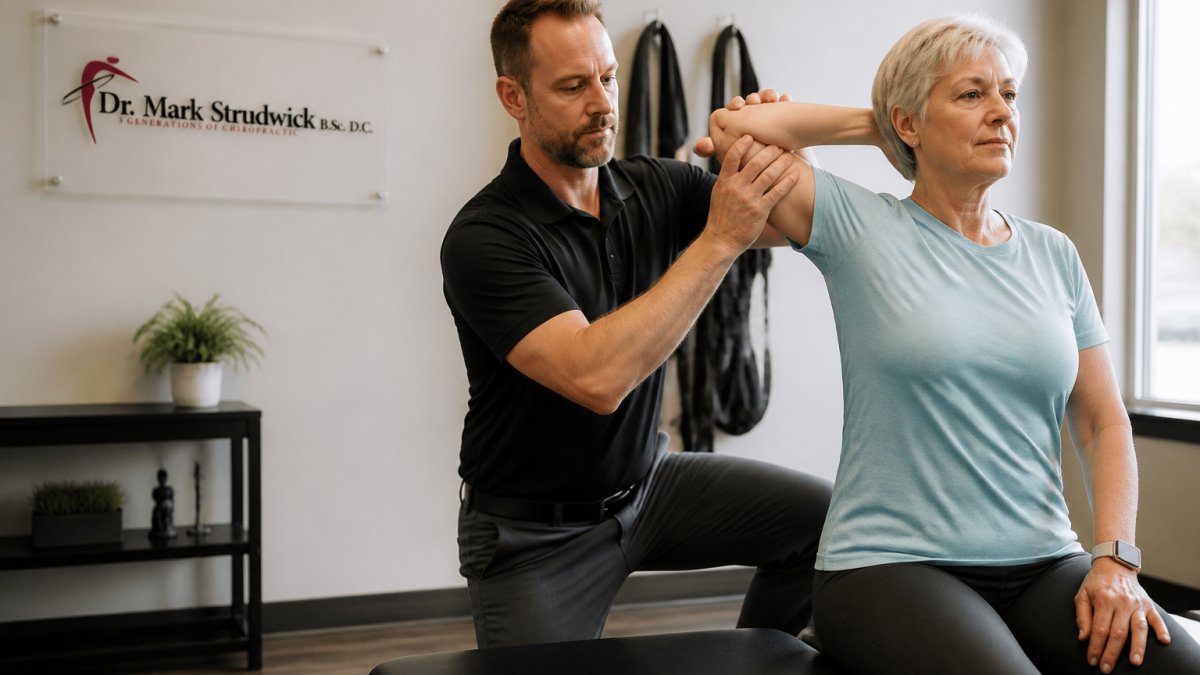
Chiropractic rehabilitation exercises bridge hands-on treatment and long-term function: joint mobilization and soft tissue work reduce pain and restore movement, while exercise keeps the change from disappearing.
That answers a fair question: why does pain come back after treatment?
Rehabilitation exercises typically fall into a few categories:
- Mobility drills to restore range of motion
- Stability work for the deep muscles that support the spine
- Progressive strengthening for hips, shoulders, and core
Chiropractic care fits best in combination: manual therapy creates a window of better movement, and exercise uses that window to build something durable.
If you are coming from a purely passive approach, expect this to feel different. You will be asked to do work between visits.
Ask for the retest date at the start, not the end. Knowing you will be reassessed in a set number of weeks keeps the plan honest and stops treatment from drifting into an open-ended schedule.
Choosing a Provider and What Sessions Involve
Choosing a provider comes down to four things: credentials, assessment process, communication, and how billing works. Get clarity on all four before you commit to a plan. This section is written to help you compare options, not to sell one.
Credentials: what to actually look for
In this province, chiropractors are regulated by the College of Chiropractors of British Columbia, kinesiologists by the British Columbia Association of Kinesiologists, and physiotherapists by the College of Physical Therapists of British Columbia. Whatever the title, the useful signal is post-graduate training in movement assessment or rehabilitation, sports chiropractic certification, functional movement screening certification, or rehabilitation-focused continuing education. Ask what the practitioner does beyond entry-level practice.
The main approaches you will encounter
Functional movement care is not one thing. The three common approaches differ in what they emphasize and who they suit:
| Approach | What it emphasizes | Best suited for |
|---|---|---|
| Chiropractic + rehab | Manual therapy to open a window of better movement, then exercise to build capacity | Pain with a mechanical driver; people who want hands-on treatment plus a home program |
| Kinesiology-led training | Progressive loading, movement retraining, and program design | People past the acute stage who want structured strength and conditioning |
| Physiotherapy | Assessment, manual therapy, and exercise, often with a rehabilitation focus | Post-injury or post-surgical recovery; cases needing close clinical monitoring |
Many people benefit from more than one. A chiropractor may handle the acute phase and hand off to a kinesiologist for the strength-building phase. Ask how the practitioner coordinates with others if your needs change.
Assessment process
A provider who examines before treating is worth keeping. Ask what they test, how they decide on a plan, and whether they retest at set intervals. One who cannot describe their assessment process in plain language is a warning sign.
Communication
You should get a clear explanation of findings, a realistic timeline, and an honest note on what treatment can and cannot do. If a provider promises a fixed number of visits before assessing you, or guarantees you will be pain-free, treat that as a red flag.
Billing and coverage
Ask about direct billing to extended health insurers, ICBC, and WorkSafeBC before your first appointment, it removes a real source of stress. Confirm whether your insurance plan’s coverage , and ask what a visit costs out of pocket.
| What to check | Why it matters | What to ask |
|---|---|---|
| Credentials and training | Signals depth beyond entry-level practice | What post-graduate training do you hold? |
| Approach and fit | Different approaches suit different needs | Which approach do you recommend for my goal, and why? |
| Assessment approach | Separates structured care from guesswork | What do you test before treating, and when do you retest? |
| Communication style | You need to understand the plan | How will you explain findings and timelines? |
| Billing and coverage | Avoids surprise costs | Do you direct bill my insurer, ICBC, or WorkSafeBC? |
| Location and access | Affects whether you actually keep appointments | Is parking available, and what are your hours? |
On cost: pricing depends on the type and length of the visit, and rates vary by clinic and practitioner.
Active individuals and desk workers who want a structured assessment and a plan they can retest, rather than open-ended passive treatment. If you are past the acute stage and want a strength-focused program, a kinesiology-led approach may fit better; if you are recovering from a recent injury or surgery, a physiotherapy-led plan may be the safer starting point.
Conclusion
The hard part is not finding someone to crack your back. It is finding a provider who assesses first, explains the findings, and gives you a plan with a retest date attached.
At Strudwick Chiropractic, we combine evidence-based adjustive techniques, soft tissue therapy, and rehabilitation exercises with direct billing to insurance plans, ICBC, and WorkSafe.
If recurring pain or a stalled recovery has you stuck, book an assessment and get a clear answer about what is actually limiting your movement.
Frequently Asked Questions
What is a functional movement assessment?
A functional movement assessment is a structured evaluation of how you move through basic patterns like squatting, lunging, and reaching. A practitioner watches your movement quality, balance, and range of motion, then identifies limitations or structural asymmetry that may affect performance or recovery. It is not a diagnostic scan; it is a practical screen that guides exercise prescription and treatment planning. In Victoria, chiropractors, kinesiologists, and physiotherapists may all offer some form of movement assessment, though the depth and focus vary by provider.
How is functional movement training different from physiotherapy?
Functional movement training focuses on building movement capacity through corrective exercise and progressive loading, often after an initial screen or assessment. Physiotherapy tends to address acute injury, pain management, and tissue healing first. Many people use both: physiotherapy for the injury itself, then functional movement training to restore strength, coordination, and multi-plane movement before returning to sport or physical work. A chiropractor with rehabilitation training may combine adjustment, soft tissue work, and exercise prescription in one plan.
Can a chiropractor help improve movement and mobility?
Chiropractors assess posture, joint mobility, and movement patterns, then use adjustive techniques, soft tissue therapy, and rehabilitation exercises to address limitations. For office workers with neck or back pain, this often means restoring range of motion and prescribing exercises that target weak or overactive muscles. Athletes may use chiropractic care alongside functional movement training to reduce re-injury risk. The approach depends on the individual; a thorough assessment determines whether chiropractic care, exercise, or a combination is appropriate.
How do I choose a functional movement or kinesiology provider?
Look at credentials, experience with your specific goal, and whether the provider explains their assessment process clearly. Ask what a first appointment involves, how they track progress, and whether they work with your insurance or third-party coverage. In Victoria, providers range from kinesiologists focused on exercise-based rehabilitation to chiropractors who combine manual therapy with movement screening. A provider who measures outcomes and adjusts your plan based on results is more useful than one who applies the same protocol to everyone.